
Freedom through Openness: Letting Go of Attachment and Imposition
A contemplation and personal sharing of the First, Second, and Third of the 14 Mindfulness Trainings in Plum Village.
Nanala McMillan
1/13/20267 min read
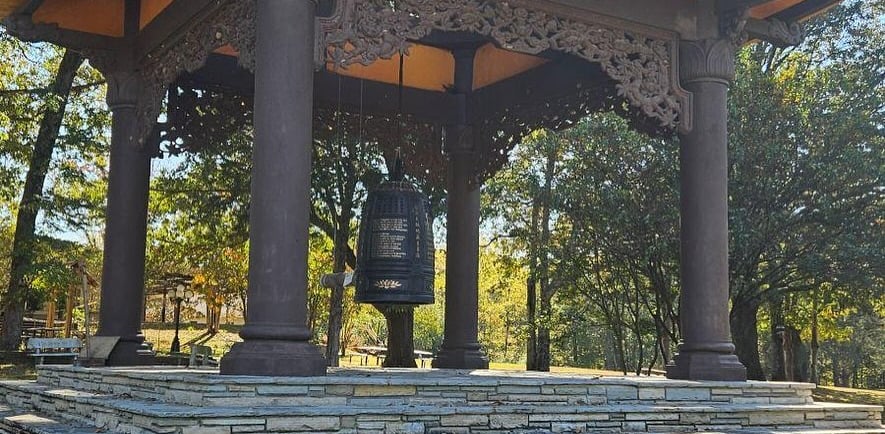
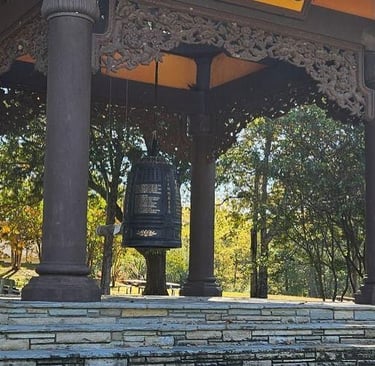
The bell tower at Magnolia Grove Monastery, taken during the 2024 Rains Retreat.
The First Mindfulness Training: Openness
Aware of the suffering created by fanaticism and intolerance, we are determined not to be idolatrous about or bound to any doctrine, theory, or ideology, even Buddhist ones. We are committed to seeing the Buddhist teachings as a guiding means that help us learn to look deeply and develop understanding and compassion. They are not doctrines to fight, kill, or die for. We understand that fanaticism in its many forms is the result of perceiving things in a dualistic or discriminative manner. We will train ourselves to look at everything with openness and the insight of interbeing in order to transform dogmatism and violence in ourselves and the world.
The Second Mindfulness Training: Non-Attachment to Views
Aware of the suffering created by attachment to views and wrong perceptions, we are determined to avoid being narrow-minded and bound to present views. We are committed to learning and practicing non-attachment to views and being open to others’ experiences and insights in order to benefit from the collective wisdom. We are aware that the knowledge we presently possess is not changeless, absolute truth. Insight is revealed through the practice of compassionate listening, deep looking, and letting go of notions rather than through the accumulation of intellectual knowledge. Truth is found in life, and we will observe life within and around us in every moment, ready to learn throughout our lives.
I originally was going to write these blogs going one-by-one through the trainings. After considering the topics I would be covering, it is very difficult to talk about Openness without also addressing Non-Attachment to Views and Freedom of Thought. After all, they inter-are.
We can all benefit greatly from the quality of Openness in our mind, body, and actions. I think it is the first training for a reason, without openness how can we look deeply to begin with? We see in many structured communities, whether it be religious or an organization (even personal values), a set law or rules that are expected to be followed. Rules are not inherently bad and help us protect ourselves and others, but it is easy to fall into the trap of viewing these rules in our life as absolute truth. When we attach ourselves to these views, we become fanatic and they become dogma. Attachment in itself is the creation of suffering, even attaching ourselves to wholesome guidelines can and will create suffering. The act of attachment dilutes the original purpose of these rules and guidelines in our lives meant to steer us to nourishment of our wellbeing.
Practicing Openness allows us to view life through a Beginner's Mind, a fresh perspective not trapped in a defined box. Some guidelines, morals, and texts may resonate with me the most and help me grow in a profound way, but what makes them the absolute truth? There are many dharma doors--methods of practice leading to liberation of suffering--that manifest in our lives. No one absolute way. Having Openness is allowing ourselves to look at our own life with a growth mindset. I understand my trainings work for me, but they may not work for others. Or maybe someone shared something with me and it's not my practice, but I resonate with it and can allow that to change and shape my current perspectives. I am open to learning, reassessing my views, and growing with these changes.
The mantra, "are you sure?" is a beneficial practice I have found in my life. Sometimes someone shares something with me and I feel aversion 'that's not right' but allowing myself to pause and ask myself "are you sure?" opens a wider lens allowing me to bring mindfulness into my gaze. I am open to their views and practices, even if I personally do not resonate with them. This waters the seeds of compassion and understanding. I do not need to share in a way that promotes my practices as the only way to attain peace, understanding there are many vehicles to peace. I practice being open to others experiences and open to my own views changing and growing.
When we practice Non-Attachment to Views, every moment becomes an opportunity to learn and gain insights. When we are attached to what we think we know, we lock ourselves away from others and the world. To promote peace, compassion, and understanding among humanity, we need to be able to co-exist in a way that is open to all walks of life. We can respect one another without having to sacrifice our own morals and way of life. Even views we may understand as "outlandish", we should keep our heart open to. In fact, how can we touch the awareness of peace and suffering if we only experience one lens of life? It is through openness, non-attachment, reflection, and experiencing others views that we are able to form our own morals and values.
The Third Mindfulness Training: Freedom of Thought
Aware of the suffering brought about when we impose our views on others, we are determined not to force others, even our children, by any means whatsoever — such as authority, threat, money, propaganda, or indoctrination — to adopt our views. We are committed to respecting the right of others to be different, to choose what to believe and how to decide. We will, however, learn to help others let go of and transform fanaticism and narrowness through loving speech and compassionate dialogue.
Through the attachment of views and lack of openness, it accumulates into the imposing of our views onto others. We see this on a large scale through civil and world wars fought over views being held as absolute truth. "We are the only true religion. My views are ultimate law. This is my land because our views say so." We also see it on a smaller scale between parents and children, forcing generational religious practices on children and how they must spend their lives by what career they must take in college to make the most money. All of this indoctrination is connected and contributes to a world of suffering as people lose their sense of autonomy and are faced with confliction and idolatrous beliefs. In my experience and shared experiences with many friends growing up, children end up repressing their emotions and desires out of shame due to indoctrination, which leads to secrecy and rebellion, turning them into uncharted territories without guidance which develops addiction, habitual lying, and depression.
I can only speak from my experience, but a common theme in the United States among children and students is the heavy expectation to achieve academic and religious success. Parents vicariously live through their children by defining their worth as a fancy title, six-figure salary, marrying a person within their religion and house of worship (church, temple, etc), having many children, and so on. These traditional values have defined our society and the deep-rooted attachment is a poison among people. Creating these expectations we must live up to creates discomfort, fear, and suffering among those who see a life outside of them. This in turn creates a restless society that is constantly toying the edge of burn out, depression, anxiety, and lack of purpose.
When we practice Freedom of Thought, we acknowledge the right for people to choose what path to walk in life. Supporting others aspirations harbors a sense of community, love, understanding, and respect. Necessary qualities in order to have healthy relationships. Your relationship to another being does not give you authority over them to decide how they spend their life and what they must believe in. The diversity of humanity is what makes life so beautiful, a vast array of expressions and cultures. We should cherish one another and seek to understand and connect across all beliefs. Thich Nhat Hanh promotes "double belonging", which is the practice of letting go of dualistic thinking and inviting multiple branches of practice and viewpoints into our lives without contradiction. I have found this beneficial to my own practice and understanding others. Instead of dimming another's spark, let's practice to lift them up and support their ideals even if not aligned with our own.
That is not to say we should turn a blind eye to others attachment and harmful ideologies. However, instead of condemnation and cancel culture, we can invite loving speech and compassionate listening in order to promote reconciliation, understanding, and taming the fires within. A gentle rain across a flame, not feeding fire with more fire. This creates a safe-space where the other is less averse to looking inwards because they are not feeling attacked or controlled by our own attachment to views. We can lead with positivity and a stable mind in order to inspire others, lead by example. I know when people tell me not to do something, a wall can build up in front of me that is hard to hear past. How dare they tell me what to do, how dare they tell me what I am saying is wrong. I think a lot of us can relate to that. Now, if we seek to understand and ask why they think that way and open compassionate dialogue from a place of calm, we respond much better. I find myself practicing this in my life when faced with the parents of my friends and loved ones who seek to control and impose their beliefs, tearing down our own lifestyles. It is a difficult journey, but one that has been opening up new perspectives and allowing me to better understand their suffering. I feel more compassion than anger now as I actively aspire to reconcile and build a relationship with them from mutual respect even if we share different life ideals. Generational conditioning is a deep-rooted suffering that is not easy to unknot, but when we touch the insight of interbeing we can see that those imposing their beliefs are not outside of ourselves and that we can practice for them. Everyone was once a kid who was spoon fed what to believe and how to act. In times of turmoil, let's see that inner-child in everyone and offer an embrace of compassion.
---
These are the first three of the 14 Mindfulness Trainings, a collective path towards the wellbeing of all. Opening our hearts and mind to the boundless possibilities of life opens a doorway to reconciliation and compassion within ourselves and loved ones.
**This is a personal reflection of the Trainings and how they manifest for me. Practicing Openness, Non-Attachment to Views, and Freedom of Thought, we are aware that these Trainings may manifest differently for others.
Click Here to read the 14 Mindfulness Trainings.
Smile & Be Well,
Nanala
Dear friends, I have been inspired and moved to reflect on the 14 Mindfulness Trainings in a way where I can share with others my contemplations, understanding, and personal experiences. I hope my reflections can deepen my own practice while allowing others to touch similar insights and open a new door.
What are the 14 Mindfulness Trainings?
They are a global ethic serving as a guiding light--the North Star--in order to inspire peace and touch the insight of interbeing (the interconnectedness of all things). These Trainings shine a light in every aspect of our individual and communal lives on a personal and global scale in order to point us to a deeper awareness--freeing us from the notion of a separate self and the contribution to suffering.
The 14 Mindfulness Trainings were created in 1966 by Zen Master Thich Nhat Hanh, but have been reviewed and updated over the years in order to stay Engaged with the world's needs. They are the Bodhisattva ideal, pointing us towards creating harmony in ourselves, our relationships, and our collective community on Earth.